

Reflections from Nathan Baranowski's session at EntreConf 2026 on entrepreneurship, creativity and the future of innovation.
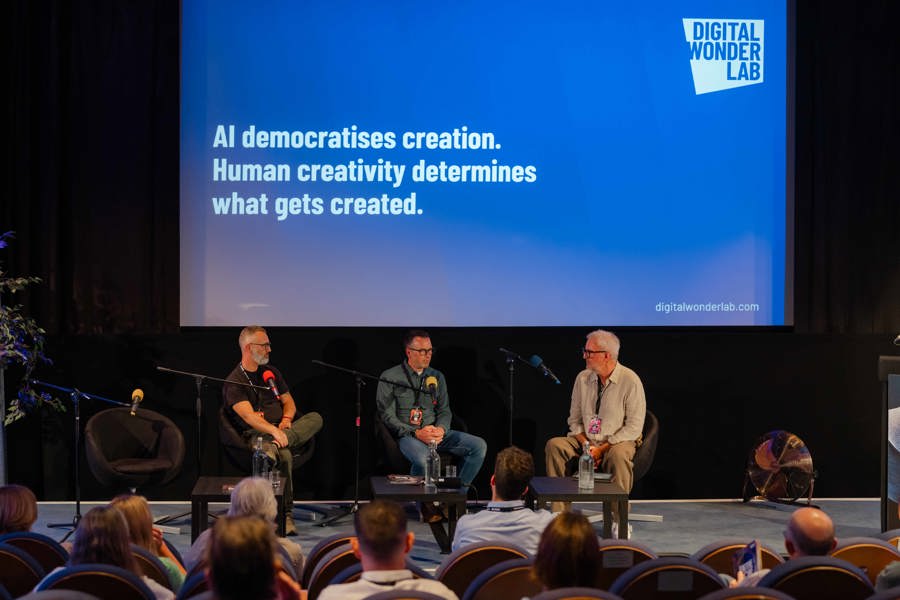
Last week, I had the privilege of speaking at EntreConf in Bristol about a question that sits at the heart of much of today's AI debate:
Is AI democratising creation?
Rather than opening with slides, statistics or predictions, I started with a short film.
No introduction.
No explanation.
Just the film.
The audience watched a visually rich piece combining AI-generated imagery, music and storytelling. When it finished, I shared something that surprised many people in the room.
The video had been created in less than two hours.
More importantly, it had been created by someone who had never made a film like that before.
A few years ago, producing something similar might have involved a creative agency, a production company, musicians, editors, weeks of effort and a significant budget. Today, powerful creative tools are available to almost anyone with an internet connection and a willingness to experiment.
The technology itself is impressive but the technology isn't the story.
The story is what happens when the barriers to creation begin to disappear.
The Cost of Creation Has Collapsed
Throughout history, access to creativity has often been limited by access to resources.
If you wanted to make a film, you needed equipment.
If you wanted to record music, you needed a studio.
If you wanted to build software, you needed developers.
If you wanted to create marketing campaigns, you needed designers, copywriters and production teams.
Today, many of those barriers are being dramatically reduced.
AI tools can help individuals generate imagery, create music, build prototypes, write content, analyse data and even develop software.
This doesn't remove the need for expertise, nor does it diminish the value of skilled practitioners. It does however fundamentally change who gets to participate.
The cost of creation has collapsed.
And when the cost of creation collapses, entrepreneurship changes, ideas move faster, experiments become cheaper and possibilities expand.
The question is no longer whether something can be created, it's increasingly become about whether we are prepared to create it.
"The technology is impressive. But the technology isn't the story."
The Future Belongs to the Fastest Learners
One of the key themes I explored at EntreConf was that AI is not simply a productivity tool. It's an experimentation tool.
Historically, businesses spent enormous amounts of time trying to avoid failure and understandably so when failure has been expensive.
Ideas often required significant investment before they could be tested.
Now, entrepreneurs can prototype concepts over a cup of tea.
They can explore multiple approaches before committing significant resources, test ideas in hours rather than months, and can learn faster.
Perhaps the most important shift is not technological at all.
It's cultural.
The technology has accelerated. The mindset hasn't.
Many organisations are still operating at the speed of the old world while the possibilities of the new world continue to expand around them.
The businesses that thrive over the coming years may not be those with the best ideas, but those that learn, adapt and experiment the fastest.
If Everyone Has AI, What Becomes Valuable?
Perhaps the most interesting question from the session was this:
If everyone has AI, what becomes valuable?
Because eventually these tools become available to everyone.
Just as email became ubiquitous.
Just as search engines became ubiquitous.
Just as smartphones became ubiquitous.
The technology itself rarely remains the differentiator.
So what does?
Human qualities.
Curiosity.
Creativity.
Empathy.
Connection.
Judgement.
Imagination.
One of the great ironies of AI may be that as technology becomes more capable, the qualities that make us human become more valuable.
There is a useful analogy here.
We've all had access to the alphabet for most of our lives but having access to the alphabet doesn't make us authors, journalists or poets.
The tool is available to everyone.
What Matters is What we Choose to do with it.
AI is no different.
It can help us write, design, code, compose music and create films.
But access to the tool does not automatically create originality, insight or meaning.
AI can generate options but it can't decide what matters.
AI can create content but it can't create meaning.
AI can produce answers but it doesn't know which questions are worth asking.
The organisations that succeed won't simply use AI, they'll combine it with imagination, empathy, curiosity and judgement.
If everyone has AI, what becomes valuable?
• Curiosity
• Creativity
• Empathy
• Judgement
• Imagination
• Trust
Creation and Responsibility
Of course, democratising creation also brings responsibility.
The ability to create at scale raises important questions around trust, transparency and ethics.
Just because we can create something doesn't necessarily mean we should.
As AI becomes embedded in the way we work, build and communicate, leaders must continue asking important questions:
• Is it true?
• Is it fair?
• Is it transparent?
• Does it build trust?
Because while AI may democratise creation, trust remains stubbornly human.
And trust may become one of the most valuable assets in the AI economy.
So, Now What?
Most conversations about AI focus on models, tools and technical capability.
But perhaps that's the wrong question.
The real question isn't:
What can AI do?
The real question is:
What will we do with it?
Every entrepreneur now has access to capabilities that would have seemed extraordinary just a few years ago.
The challenge is no longer access.
The challenge is action.
What will you build?
What will you test?
What opportunity will you pursue?
What problem will you solve?
Because while AI may be democratising creation, human creativity still determines what gets created.
And that may be the most exciting opportunity of all.
"AI may democratise creation. Human creativity still determines what gets created."
About the Author
Nathan Baranowski is Founder and Co-CEO of Digital Wonderlab, an award-winning digital innovation consultancy helping organisations navigate complexity, embrace emerging technologies and create meaningful digital products, services and experiences. Nathan works with organisations across health, education, government and the private sector to turn ideas into impact through strategy, design, technology and innovation.