
 Umbraco Platinum Partner


A few times a year a client tells me their members are already talking to each other, just somewhere else. Usually it's a Facebook group a former colleague set up and nobody has the admin password for, or a WhatsApp chat that's impossible to search. They'd like that conversation on their own website.
We needed a good forum for Umbraco and couldn't find one. The choice was a third-party forum on a different domain with a second login, or one of a couple of Umbraco packages that hadn't kept up with recent versions. And even when the software is there, the thing that stops most organisations putting a forum on their site is moderation. Someone has to read every post, and nobody has the time.
So we built Community Forum and Community Comments, two free packages for Umbraco 17, and used Umbraco.AI to take as much of that burden off people as we can. They went live on the Umbraco Marketplace last week.
Forums didn't go away
For a format that supposedly died in about 2012, forums turn up an awful lot in search results, and they're one of the places AI assistants pull their answers from. A question asked by a real person and answered by someone who knows is exactly what people search for, and your members write it for free.
If that conversation happens on your own site it stays yours. It's indexed under your domain, it's still there after the next platform change, and it sits next to the rest of your content. The forum outputs the structured data search engines look for on discussion and Q&A pages, has a sitemap and RSS feeds, and keeps members-only boards out of all of them.
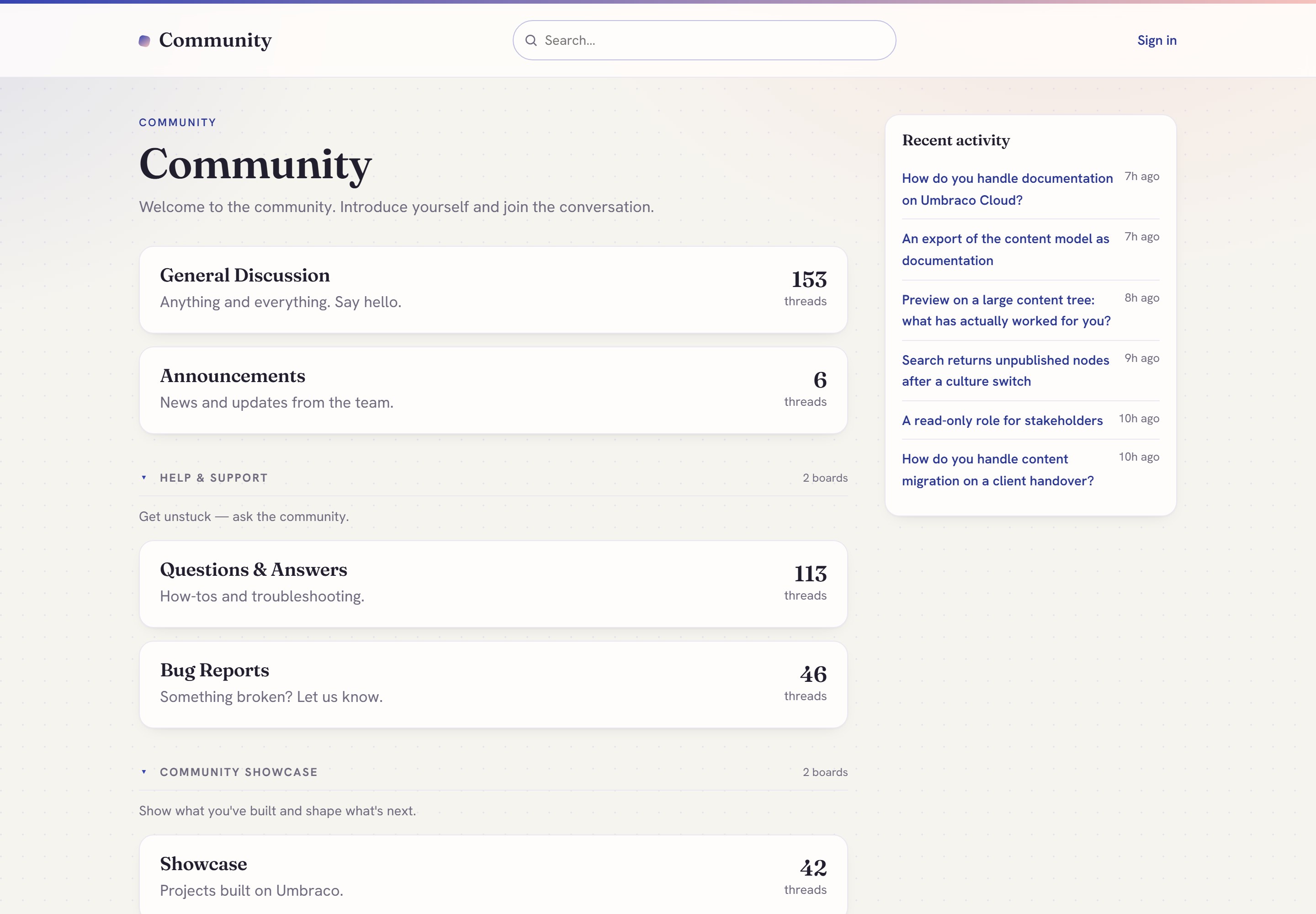
Community Forum has boards and categories, threads, tags, polls, reactions, Q&A boards with accepted answers, @mentions, notifications, direct messages, search and reply emails. Community Comments puts comments on any page, either by adding a block or a line in a template. You can run either on its own. Run both and they share the same member accounts and the same moderation.
Moderation is the hard bit
In my experience most community features don't fail because the software is bad. They fail because nobody has the time to moderate them, and the job falls to whoever in the comms team drew the short straw.
The people who should be moderating a community are usually volunteers, subject experts or long-standing members, and you don't want to hand any of them a login to the website's backoffice. So moderators work on the website itself. Put a member in the Moderators group and they get a moderation queue inside the forum, and can approve or remove comments on the page they're on. The web team still has a single queue in the backoffice for everything.
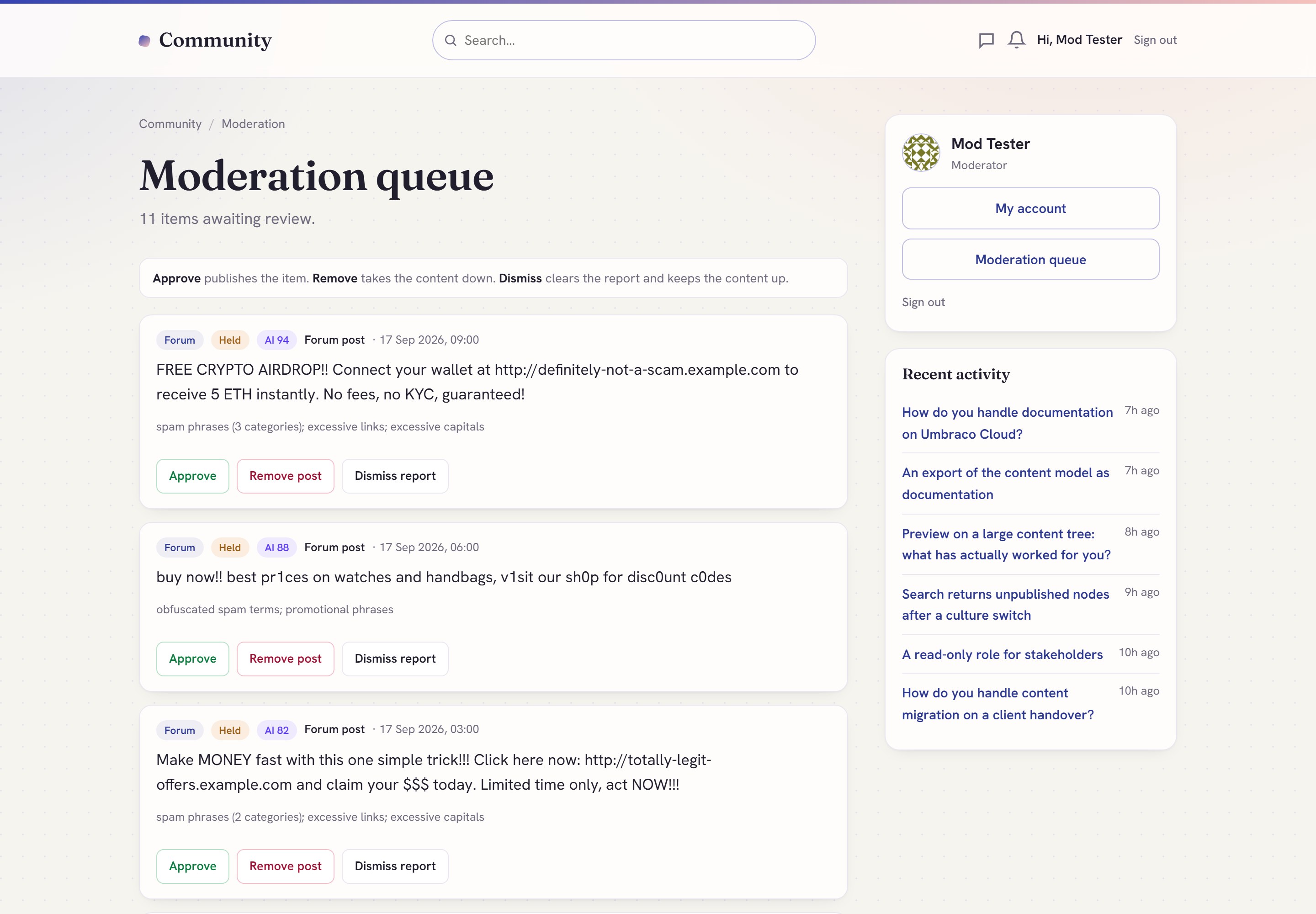
Before any of that, every post and comment is scored by a rules engine. It looks for links, phone numbers and email addresses, known spam phrases, swearing and the creative spellings people use to get round swear filters, plus any words you add yourself. High scores are held for review or rejected outright. Members can report posts, and enough reports hide a post until a moderator has looked at it. A new member's first posts can be held until they've been around a couple of days.
Where the AI comes in
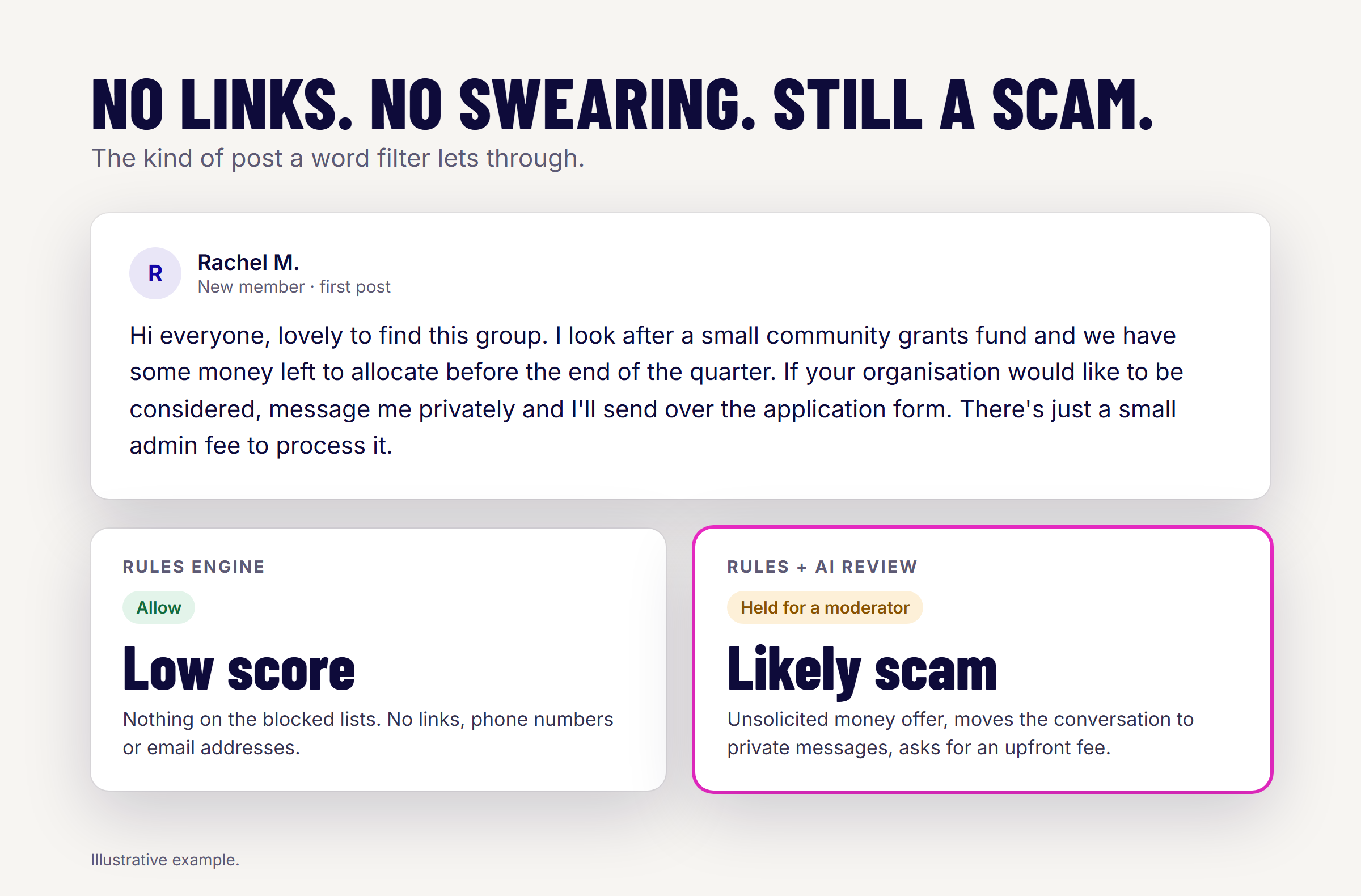
Rules catch the obvious stuff. What they don't catch is the post that's perfectly polite. Someone joins, mentions they look after a small grants fund with money left over this quarter, and invites people to message them privately for an application form. No links, no rude words, nothing a filter would blink at, and it's a scam.
The optional AI Moderation add-on reads each post the way a moderator would and adds its view to the rules engine's score. That's the kind of post it's there for. Between the two, ordinary posts go straight up and your moderators only see the handful that need a person to decide.
It's built on Umbraco.AI, Umbraco's own open-source AI layer, so you choose the provider and model and the API key stays in Umbraco.AI. Our packages never see it, and the provider bills you directly. With a small model it costs a fraction of a penny per post. If the AI service is down, slow or sends back nonsense, the rules engine decides and posting carries on as normal. Plenty of sites won't need it at all, and the rules engine works fine without it.
It behaves like Umbraco
Categories and boards are pages in the content tree, so editors already know how to manage them, and they move between environments with the rest of your content. The posts themselves are kept in their own database tables rather than as content, so a few thousand threads don't bury the backoffice or end up in your deployments. Forum users are ordinary Umbraco members, the forum can sit inside your site's own header and footer, and when a member deletes their account their personal details go and their posts are anonymised, so old threads still make sense.
You'll need Umbraco 17. Install the packages from NuGet, open the new Community section in the backoffice and run Setup, and it creates everything it needs. Docs and screenshots are at github.com/dwlgit/community-suite, and both packages are on the Umbraco Marketplace: Community Forum and Community Comments. They're free, including on sites you build for clients.
The software is the easy part
Installing a forum takes an afternoon. Working out what the community is for, who looks after it, and how to make sure the first person through the door doesn't find an empty room takes rather longer, and it's what decides whether the thing gets used.
If you're thinking about a community for your members or supporters, drop me a line and I'm happy to talk it through.


